Out-of-Pocket Cap Refunds 2026: Arrears Deduction Rules
Check your refund eligibility and application status on the National Health Insurance Service website. Arrears deductions apply when notice of an excess amount is issued on or after October 8, 2026.
Verify your identity on the National Health Insurance Service website to view your refund details.
Check the year of treatment and the amount eligible for payment for each listed item.
If you have arrears, check when the excess amount notice was issued and review the deduction details.
Check whether payment is automatic. If a separate application is required, submit your bank account details.
Compare the application processing result with the amount actually deposited.
If your annual qualifying out-of-pocket payments exceed your individual maximum, you are eligible for a refund of the excess amount. Verify your identity on the Service's website to check. Have your own bank account details ready when applying. Check the notice or contact the Service for the claim deadline. (Verified provision: The right to receive insurance benefits becomes time-barred if not exercised for 3 years. · Source: law.go.kr · Verified 2026-10-08)
The payment totals are based on the Ministry of Health and Welfare's announcement on August 30, 2026.
How to Check Refunds for Amounts Above the Out-of-Pocket Maximum
Check through the refund service on the National Health Insurance Service website. You can log in using simple authentication, a joint certificate, or a financial certificate. A direct link may open the login screen first.
· Visit the Service's website and log in as an individual.
· Under Find Services in Civil Services, find Refund Inquiry and Application.
· Check that the item listed is an amount above the out-of-pocket maximum.
· Check the treatment year and the amount payable.
· For cases requiring an application, submit it with an account in your own name.
The Service's Refund Inquiry and Application service requires identity verification. If you have difficulty using the online service, call 1577-1000. To use a family member's account, check the required documents first.
Application Period and Automatic Payment for Out-of-Pocket Maximum Refunds
The payment process for treatment received in 2025 began on August 31, 2026. The announcement also stated that notices would be sent in stages starting that day. Those who do not open the electronic document will receive a notice by mail.
Category | What to check | Next step
People with an account registered with payment consent | Registered account and payment status | Check whether payment is automatic
People who must apply separately | Payment application notice | Apply with account details
People who have not received a notice | Inquiry results from the Service | Contact a branch if the results are unclear
People with an account registered with payment consent can receive payment without applying separately. Payments for treatment received in 2025 were announced as scheduled to begin in stages on September 2, 2026. Application channels include the website, app, telephone, fax, mail, and in-person visits.
The announcement does not specify a single nationwide application deadline. This does not mean there is no claim deadline. Check your notice or contact the Service for your individual claim deadline. (Verified provision: The right to receive insurance benefits becomes time-barred if not exercised for 3 years. · Source: law.go.kr · Verified 2026-10-08) The payment schedule and application channels are based on the Ministry of Health and Welfare announcement.
Comparing Maximums by Treatment Year
The 2025 maximum applies to payments received in 2026 for treatment received in 2025. The 2026 maximum applies to treatment received in 2026. Choosing the maximum based on the year you receive payment will change the calculation.
Treatment year | Cases not involving hospitalization for more than 120 days in a long-term care hospital | Hospitalization for more than 120 days in a long-term care hospital
2025 | KRW 890,000 to 8,260,000 annually | KRW 1,410,000 to 10,740,000 annually
2026 | KRW 900,000 to 8,430,000 annually | KRW 1,430,000 to 10,960,000 annually
The amounts in the table show the range of maximums across insurance premium brackets. Individual amounts are determined based on health insurance premiums and other factors for the treatment year. Do not determine your bracket based only on your current monthly salary. Detailed brackets are available in the Service's guide to the out-of-pocket maximum system.
Dependents, as well as insured members, may be eligible for payment. The annual calculation period runs from January 1 to December 31. Qualifying out-of-pocket payments made at multiple hospitals, clinics, and pharmacies are added together.
Why the Refund Differs from the Total on Your Medical Bills
Not all money paid to a hospital is included in the out-of-pocket maximum calculation. Some items are excluded even when treatment is covered by health insurance. Simply subtracting the maximum from the total on your receipts can overestimate your refund.
· Non-covered services, selectively covered services, and amounts paid entirely by the patient are excluded.
· Implants and hospitalization charges for 2- or 3-person rooms are also excluded.
· Patient copayments for Chuna therapy are also excluded.
· Medical expense assistance from the national or local governments is accounted for through adjustments in the calculation.
Other treatment items are excluded in addition to those listed above. For details, see the Service's system guide. Check the Service's calculation breakdown to determine whether individual medical expenses qualify.
Payment method | How it works | What to watch for when checking your refund
Advance benefits | The same medical institution bills the Service directly for amounts above the threshold | Check amounts already processed by the hospital
Retrospective refund | Annual qualifying out-of-pocket payments are added together and paid to the individual | Do not count amounts already processed as advance benefits twice
A total of 2,262,605 people are eligible for payments for treatment received in 2025. The total payment amount was announced as KRW 3,076,000,000,000. This total does not represent the amount scheduled to be deposited into any individual's account. The figures are based on the summary of the Ministry of Health and Welfare announcement published by KDI.
Conditions for Deducting Arrears by Notification Date
Deductions for arrears apply starting with amounts notified on or after October 8, 2026. The amended law allows payment after deducting overdue insurance premiums and other amounts owed. Do not determine whether a deduction applies based only on the deposit date.
This shall apply beginning with cases in which notice of the excess amount is given under the latter part of paragraph 2 of the same Article on or after this Act takes effect.
This is the wording of Article 2 of the Addenda to the Act Partially Amending the National Health Insurance Act. You can check the application provision in the enactment and amendment text at the National Law Information Center. Deductions cover insurance premiums and amounts collected under the law that the person concerned is required to pay.
Situation | What to check
Notice received before the effective date, with payment deposited after it | The deposit date alone does not establish that the new deduction rules apply
Notice of the excess amount received on or after the effective date | Check for arrears and the deduction amount stated by the Service
Notification date is unclear | Ask the Service to check the notification history for the case
If a deduction applies, the remaining balance is the amount payable minus the deduction. If the deduction equals the entire amount payable, there may be no deposit. Do not interpret the existence of arrears as meaning you are not eligible for a refund at all.
What to Check When the Estimated Amount and Deposit Differ
Check calculation differences separately from deductions made at the payment stage. The first concerns which medical expenses qualified. The second concerns what was deducted from the calculated amount.
· Check that the treatment year on your receipts matches the refund case you looked up.
· Check excluded medical expenses and how medical expense assistance was reflected.
· Check the maximum applied and any amounts processed as advance benefits.
· Check when you were notified of the excess amount and how much was deducted for arrears.
· Compare the Service's final payment details with the deposit record in your bank account.
When making an inquiry, specify which items differ. For example, distinguish between a difference in the calculated amount and a difference only in the deposited amount. This distinction reduces how much you need to recheck from the receipts onward.
Documents for Family Accounts and Applications by a Representative
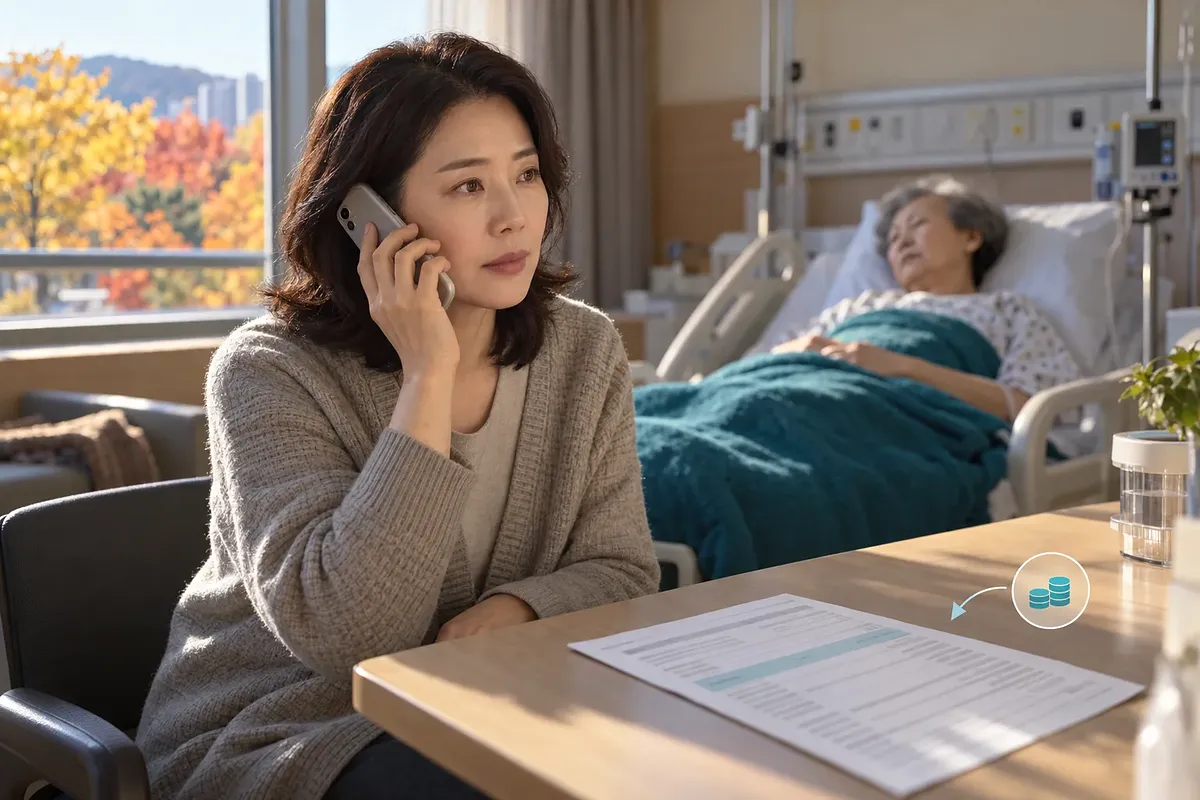
Documents required for a family member's account vary by relationship and amount. Ask separately about payment into a family member's account and applying on someone else's behalf. The Service's guidance defines family members as spouses, parents, children, grandchildren, and grandparents.
Application situation | Main documents to check
Family member's account, at most KRW 300,000 | Payment application form, family relationship certificate
Family member's account, more than KRW 300,000 | Payment application form, power of attorney, detailed family relationship certificate, copies of both parties' identification
Application using a family member's account due to dementia, unconsciousness, or similar circumstances, more than KRW 300,000 | Payment application form, medical certificate or doctor's opinion, detailed family relationship certificate, copy of the account holder's identification
The detailed family relationship certificate must have been issued within 3 months before the application date. The medical certificate or doctor's opinion must have been issued within 6 months before the application date. For siblings and others, check the separate rules for third-party accounts.
Document requirements follow the Service's guide to required documents by application type. Powers of attorney and other forms are available in the collection of retrospective refund application forms. Before submitting, check with your local branch about submission methods and any additional documents.
 OnBinder