OnBinder
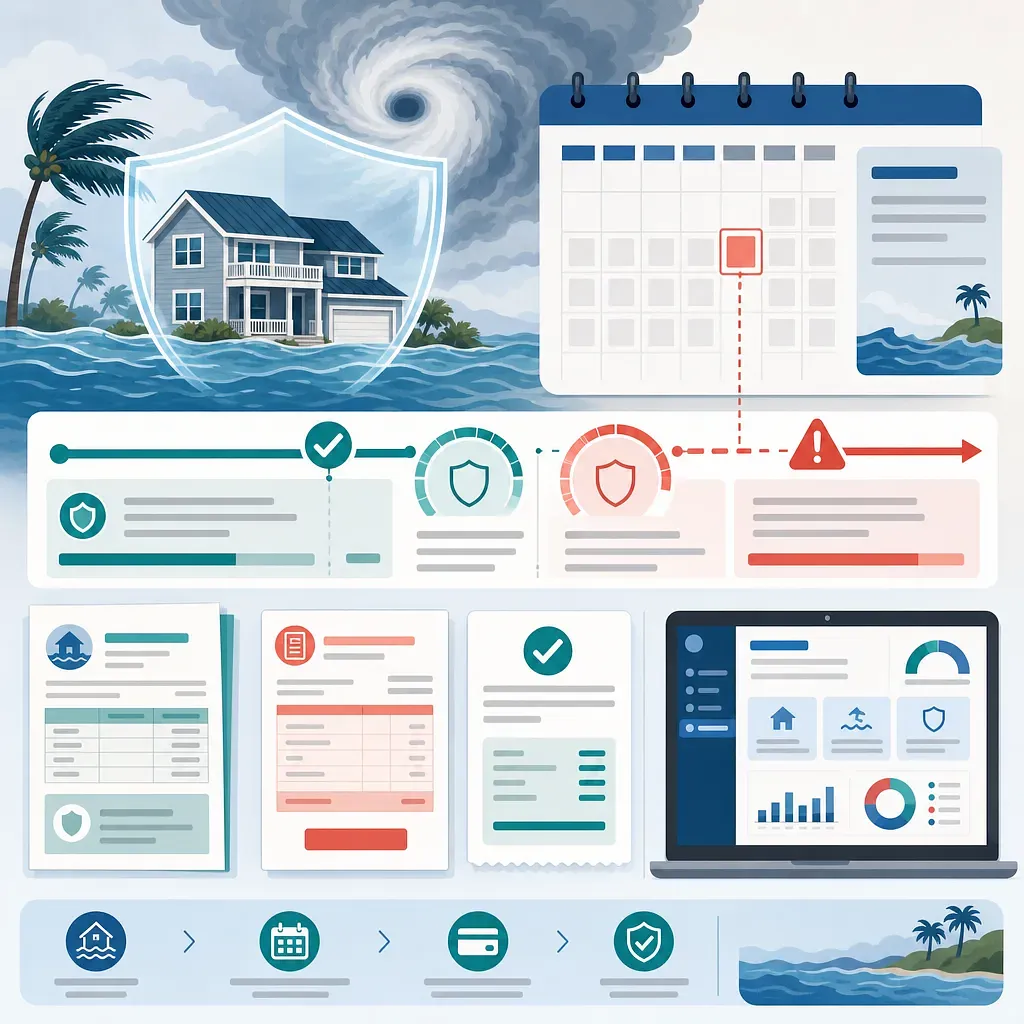
To maintain your NFIP (National Flood Insurance Program) flood insurance, first check the policy expiration date and the insurance company that manages the policy. A standard NFIP policy generally runs for one year and does not renew automatically. The 30 days after expiration are not a period of unconditional, free extended coverage; they are a grace period during which the full renewal premium must be received by the specified deadline for the existing policy to be renewed without interruption.
How to Renew Now
1. Check Renewal Eligibility and the Expiration Date
If you want to maintain your currently active NFIP policy, check the following items on the policy or renewal bill.
- Policy expiration date
- Policy number or Policy Number
- Insurance company managing the policy
- Whether it is an NFIP Direct policy
- Renewal premium and payment status
- Whether the premium is paid from a mortgage escrow account
If the expiration date has passed, immediately determine whether you are within 30 calendar days of that date. Rather than initiating payment on the last day of the grace period, it is safer to allow sufficient time based on the date the insurance company actually receives it.
2. Choose a Renewal Method
Policies managed directly by NFIP Direct can be renewed through the official renewal page. Online verification generally requires the following information.
- NFIP policy number
- Bill ID or invoice ID shown on the renewal bill
- Renewal premium payment method
If the policy is a Write Your Own policy sold and managed by a private insurance company on behalf of NFIP, you must renew it through that insurance company or the insurance agent handling the policy. Do not apply for a new policy first simply because your policy does not appear on the NFIP Direct page; first check the servicing company listed on your policy.
3. Pay the Full Premium
The safest approach is to ensure that the full renewal premium is received before the expiration date. After payment, keep the receipt, confirmation number, receipt date, and renewed policy.
If the premium is paid from an escrow account, do not assume that the lender will handle it; verify that payment was actually made. Also check whether the bill was sent to both you and the lender and whether the amount paid was the full renewal premium.
4. Check the Renewal Status After Expiration
Even within 30 days after expiration, the premium is not paid automatically. Ask the insurance company to confirm the following.
- Whether it can be processed as a renewal of the existing policy
- The full amount of the required premium
- Whether the premium was actually received in the system
- What claim documentation is required if a flood loss occurred during the grace period
If the full amount is received within the grace period and qualifies as a continuous renewal, the policy may be processed as continuing from the time immediately after the original expiration date. A loss occurring during the grace period must also satisfy the renewal conditions and the policy’s coverage requirements, and payment of the premium alone does not automatically approve every claim.
5. Check the Waiting Period if the Policy Has Lapsed
If more than 30 days have passed since expiration and the existing policy has lapsed, it will generally be processed as a new application. In that case, the 30-day waiting period applies again in principle, so a flood occurring immediately after the application may not be covered. Discounts or rating benefits that applied under the previous policy may also be affected, so confirm this separately with the insurance company.
Difference Between the 30-Day Grace Period and the 30-Day Waiting Period
Although the two periods are the same length, they serve opposite functions.
| Category | When It Applies | Key Condition | Coverage Result |
|---|---|---|---|
| Renewal grace period | Within 30 days after an existing NFIP policy expires | The full renewal premium must be received within the period | If the conditions are met, it may be processed as a continuous renewal of the existing policy |
| New policy waiting period | New enrollment or reenrollment after a lapse | In principle, a 30-day wait after application and premium payment | Floods occurring during the waiting period are generally not covered |
| Standard renewal before expiration | Renewal completed before the existing policy expires | Full premium received | An unnecessary lapse and the waiting period for reenrollment can be avoided |
The grace period is a rule that gives existing policyholders an opportunity to complete their renewal payment. It is not a rule allowing an uninsured person to obtain retroactive coverage after seeing a storm or flood forecast.
Major Exceptions to the 30-Day Waiting Period for New Policies
The 30-day waiting period does not apply to every application. However, because exceptions require specific transaction timing and documentation requirements to be met, you should confirm their applicability with the insurance company.
| Exception Type | General Purpose | Items to Confirm |
|---|---|---|
| Mortgage loan transaction | Mandatory insurance enrollment directly linked to the origination, increase, extension, or renewal of a loan | Timing of the application and premium payment, loan closing date, and documents required by the lender |
| Flood hazard map change | Encourage enrollment for properties whose hazard zones changed due to a map revision | Applicable period after the revised map takes effect, requirements for additional or new coverage, and whether a 1-day waiting period may generally apply |
| Flooding after a wildfire on federal land | Cases in which conditions following a wildfire on federal land caused or worsened flooding | Whether FEMA requirements are met, the policy purchase date, the actual flood date, and the wildfire’s impact |
Do not assume that coverage begins immediately based on your own conclusion that an exception applies. Obtain written confirmation of the effective date from the insurance company and keep the renewal or enrollment confirmation.
Additional Items to Check for Mortgage Escrow Payments
Even if the lender or mortgage servicer pays the premium from an escrow account, you should not assume that you have completely transferred responsibility for maintaining the policy. Payment can be delayed due to billing delivery errors, a change in servicing companies, an insufficient escrow balance, or a premium change.
- Before expiration, confirm with the lender whether it received the renewal bill and ask about the processing schedule.
- Separately verify the record showing that the premium was paid and the record showing that it was received by the NFIP policy.
- If the mortgage servicer has changed, provide the new company with the policy number and bill.
- Before making a duplicate payment yourself, ask the insurance company and lender how refunds and reconciliation will be handled.
This verification process is a practical step that can easily be missed when relying only on official renewal guidance. Especially during the grace period, the actual receipt status in the insurance company’s system matters more than an explanation that “the lender sent it.”