If you are the named holder of the electricity contract for your residence and meet the PVPC tariff and at most 10kW requirements, you may apply through the income, pension, or large-family pathway. The 2026 discount rates are 42.5% or 57.5%. These rates will remain in effect through December 31, and applications must be submitted directly to a reference retailer.
Reconfirmed as of August 31, 2026
Eligibility to Check Before Applying
The Bono social eléctrico is a discount on the regulated electricity tariff for a residence. The applicant must be the individual named on the electricity contract. The home covered must be the applicant’s primary residence.
Check that all three of the following contract conditions are met.
- The contracted tariff must be PVPC.
- The contracted power must be at most 10kW.
- The contract must be with a reference retailer.
If you currently use a free-market tariff, the discount will not be applied immediately. You must first switch to a reference retailer’s PVPC tariff. Check the termination terms of your existing contract with your current provider.
A vulnerable consumer may qualify through one of the following pathways.
- Meeting the income threshold based on household composition
- Holding valid large-family status
- Having a household member who receives Minimum Living Income
- Having all income earners receive only the designated minimum pension
The minimum-pension pathway has a separate income limit. The requirement for combined annual income other than pensions must be checked in the official Bono social eligibility guidance. The reference retailer’s verification result determines the final assessment.
Income Thresholds by Eligibility Condition
The assessment method for the general income pathway must be checked in the official Bono social eligibility guidance. The threshold for a one-person household must be checked in the official Bono social eligibility guidance. The threshold when additional adult household members are added must be checked in the official Bono social eligibility guidance. The threshold when additional minor household members are added must be checked in the official Bono social eligibility guidance.
| Household composition | Vulnerable consumer income ceiling | Severely vulnerable income ceiling |
|---|---|---|
| 1 adult | 1.5 times annual IPREM | 50% of the vulnerable threshold |
| 2 adults | 1.8 times annual IPREM | 50% of the vulnerable threshold |
| 1 adult and 1 minor | 2.0 times annual IPREM | 50% of the vulnerable threshold |
| 2 adults and 1 minor | 2.3 times annual IPREM | 50% of the vulnerable threshold |
| 1 adult and 2 minors | 2.5 times annual IPREM | 50% of the vulnerable threshold |
| 2 adults and 2 minors | 2.8 times annual IPREM | 50% of the vulnerable threshold |
The multipliers in the table are the results of applying the household-member increment rules. The actual euro thresholds are calculated using the IPREM for the relevant year. Check the IPREM in effect when applying in the FAQ of Spain’s Ministry for the Ecological Transition.
The income ceiling when special circumstances are recognized must be checked in the official Bono social eligibility guidance. These circumstances include a disability of at least a specified level. Victims of gender-based violence or terrorism may also qualify. Severe dependency or single-parent households also require documentation.
The discounts and additional conditions for each eligibility category are as follows.
| Assessment category | 2026 discount rate | Key additional condition |
|---|---|---|
| Vulnerable consumer | 42.5% | Meets the general income pathway or a separate eligibility pathway |
| Severely vulnerable consumer | 57.5% | Generally at most 50% of the vulnerable income ceiling |
| Severely vulnerable large family | 57.5% | Annual income is at most 2 times IPREM |
| Severely vulnerable minimum-pension household | 57.5% | Annual income is at most 1 time IPREM |
| Consumer at risk of social exclusion | 57.5% | Severely vulnerable, with social services covering part of the bill |
Receiving Minimum Living Income alone does not make someone severely vulnerable. The severely vulnerable income threshold must also be met. Risk of social exclusion additionally requires intervention by social services.
Documents to Prepare for the Application
The reference retailer’s dedicated application form is the basic document. Also prepare documents verifying the identity of household members and the composition of the cohabiting household. Forms and submission methods may vary by retailer.
The following documents are generally required.
- Copy of the contract holder’s NIF or NIE
- Copies of household members’ NIF or NIE
- Individual or household registration certificate
- Documents proving family relationships or the cohabiting household unit
- Application form and consent form for access to personal information
- Copy of the large-family certificate
- Social services certificate confirming special circumstances
Not every applicant must submit every item on the list. Add only the documents relevant to your eligibility pathway. Income information may be retrieved from administrative records based on the consent form.
A large-family certificate may display an expiration date. An expired certificate is unlikely to be accepted as proof of eligibility. Special circumstances may require a document issued by social services.
Application Procedure Through a Reference Retailer
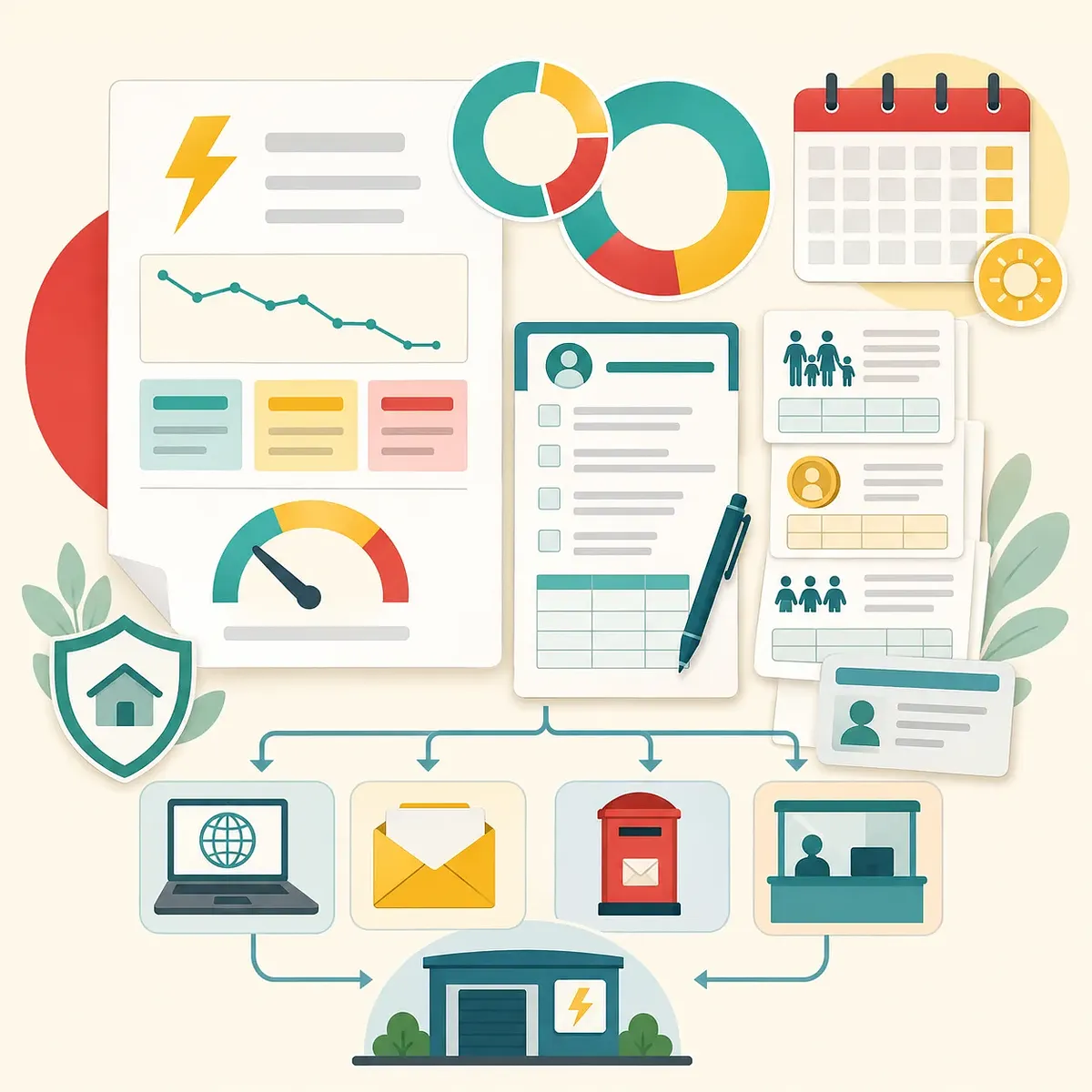
Applications are accepted by reference retailers, not through a single government payment portal. First, find the provider’s name on your current bill. The free-market brand and regulated-market company may have different names.
- Check the contract holder’s name and residence address on the bill.
- Check whether the tariff is identified as PVPC.
- Check whether the contracted power is at most 10kW.
- Select at least one applicable eligibility pathway.
- Download the application form from the relevant reference retailer.
- Attach proof of identity, household composition, and eligibility to the application.
- Submit it through the official website, by email, or another available method.
- Keep the receipt confirmation and submitted files.
Depending on the retailer, applications may be handled by telephone, email, mail, fax, or at a branch office. Some retailers also provide online submission. Check the latest contact details in the Ministry for the Ecological Transition’s list of reference retailers.
Once a complete application is received, the retailer assesses eligibility. If a request for additional information is issued, you must submit the missing documents. Also check when the result will be communicated and when the discount will appear on the bill.
Discount Calculation and Consumption Limits
Simply multiplying the final total on the bill by the discount rate may not match the actual savings. The discount applies to the contracted-power component of PVPC and eligible consumption. Taxes, meter rental fees, and other items have different billing structures.
Annual discounted consumption limits are set by household type.
| Household or eligibility category | Annual consumption eligible for discount |
|---|---|
| Individual or household without minors | 1,587kWh |
| Household with 1 minor | 1,932kWh |
| Household with 2 minors | 2,346kWh |
| Minimum-pension pathway | 2,221kWh |
| Minimum Living Income pathway | 2,221kWh |
| Large family | 4,761kWh |
The retailer allocates the annual limit according to the billing period. Electricity consumption within the limit receives the applicable discount rate. Electricity consumption above the limit is charged at PVPC without a discount.
Therefore, 42.5% or 57.5% is not a blanket discount rate for every billing item. Actual savings vary according to consumption and the billing period. Check the amount of electricity eligible for the discount separately on the bill.