Energy Voucher 2026 Eligibility for Recipients and Near-Poor
In 2026, the standard energy voucher requires both eligibility for basic livelihood benefits and compliance with criteria based on household members' characteristics. Near-poor status alone does not qualify a household, but the near-poor are included in the separate briquette conversion support program.
The standard energy voucher requires eligibility for at least one of the following benefits: livelihood, medical, housing, or education benefits.
Either the recipient or a household member listed on the resident registration certificate must meet one of the criteria based on household members' characteristics.
When checking whether a child meets the 2026 infant and young child criteria, consider both the date of birth and the requirement that the child has not yet started school and is at most 7 years old.
The near-poor are not included under the standard program's income criteria, while eligibility for the briquette conversion program is assessed under separate conditions.
Households are excluded if all members are beneficiaries residing in welfare facilities, and restrictions on overlapping support from other winter fuel assistance programs must also be checked.
The 2026 Energy Voucher requires eligibility for basic livelihood security benefits. The applicant or a household member listed on the resident registration record must also meet the household characteristic criteria. Near-poor status alone does not qualify a household for the standard program.
The criteria and amounts in this article follow the Korea Energy Agency’s 2026 program guidance.
How Energy Voucher Eligibility Is Determined
The standard program applies both income criteria and household member characteristic criteria. The voucher helps cover the cost of electricity, city gas, district heating, kerosene, LPG, and coal briquettes. After an application is submitted, the city, county, or district verifies eligibility and selects recipients.
The Korea Energy Agency’s “What Is the Energy Voucher?” specifies eligible applicants as follows.
Households that meet both the income criteria and the household member characteristic criteria
The income criteria cover recipients of livelihood, medical, housing, or education benefits. Receiving at least one of these benefits satisfies the income criteria. Household member conditions and grounds for exclusion are assessed separately.
Assessment item | What is checked
Income criteria | Eligibility for basic livelihood security benefits as of the application date
Household member characteristic criteria | Whether the recipient or a household member listed on the resident registration record meets a qualifying condition
Exclusions | Whether all household members are welfare facility benefit recipients
Restrictions on overlapping winter support | Whether the household receives other winter fuel assistance
The source is the Korea Energy Agency’s program eligibility guide.
Comparing Eligibility for Benefit Recipients and the Near-Poor
Near-poor status is not included in the standard program’s income criteria. Benefit recipients are not selected simply because they receive benefits. They must also meet the household member characteristic criteria.
Current status | Standard program’s income criteria | Additional assessment
Recipient of livelihood or medical benefits | Met | Check household member characteristics and exclusion conditions
Recipient of housing or education benefits only | Met | Check household member characteristics and exclusion conditions
Near-poor status only, without basic livelihood security benefits | Not met | Not eligible for the standard program
Meets only the elderly or disability condition and does not receive basic livelihood security benefits | Not met | Not eligible for the standard program
This table applies the official income criteria to current welfare eligibility categories. Financial hardship alone cannot replace benefit eligibility. A local administrative welfare center can confirm the types of benefits actually received.
These eligibility distinctions are based on the Korea Energy Agency’s program description.
Household Member Characteristic Criteria for 2026
The recipient or a household member listed on the resident registration record must meet one of the following conditions. Not every household member needs to meet the same condition. In addition to age, the criteria cover disability, pregnancy, diseases, and family composition.
Category | Conditions for 2026
Elderly people | Born on or before December 31, 1961, according to resident registration records
Infants and young children | Preschool children aged at most 7 who were born on or after January 1, 2019, according to resident registration records
People with disabilities | People registered as having a disability under the Act on Welfare of Persons with Disabilities
Pregnant women | Women who are pregnant or gave birth less than 6 months ago
People with severe, rare, or severe intractable diseases | People with qualifying diseases under the Criteria for Special Cases in Calculating Co-payments
Single-parent families | People eligible for support under Articles 5 and 5-2 of the Single-Parent Family Support Act
Child-headed households | People eligible for support under the Ministry of Health and Welfare’s program, including children in foster care
Households with multiple children | Households whose resident registration record includes a father or mother and at least 2 of that parent’s children under 19
The multiple-child criteria also include children in foster care listed on the same resident registration record. Disease criteria are checked against the relevant appendices to the special co-payment criteria. Appendix 3 applies to severe diseases, and Appendix 4 applies to rare diseases. Appendix 4-2 applies to severe intractable diseases.
These conditions follow the agency’s 2026 application guide card news and program eligibility guide.
Is Checking the Birth Date Enough for Infants and Young Children?
Infants and young children must also meet the condition of being preschool children. Children already attending school do not qualify under this category based on their birth date alone. Whether they meet another household member characteristic is assessed separately.
Bokjiro provides guidance on verification documents for children born in 2019 who are 7 in 2026. The required document is a certificate of exemption from or deferral of school enrollment bearing an elementary school principal’s official seal. Details are available in the 2026 application notice.
Examples of Eligibility Assessments
Meeting only the income criteria or an age condition does not qualify a household for the standard program. The table below illustrates combinations of the two criteria. Actual selection also involves checking exclusions and restrictions on overlapping support.
Situation | Income criteria | Household member characteristic criteria | Basic eligibility assessment
A housing benefit recipient personally meets the elderly criteria | Met | Met | Both criteria met
The household includes an education benefit recipient and a child on the same resident registration record who meets the infant and young child criteria | Met | Met | Both criteria met
A livelihood benefit recipient and all household members fail to meet the characteristic criteria | Met | Not met | Not eligible
The elderly criteria are met, but no one receives basic livelihood security benefits | Not met | Met | Not eligible
The household has near-poor status only and includes a person with a registered disability | Not met | Met | Not eligible
The agency’s eligibility self-check also asks separately about benefit eligibility and household member conditions. This service assesses the possibility of support based on the information entered. Its results do not replace an actual selection decision. Use the agency’s eligibility self-check to check.
Who Establishes Eligibility and Who Counts Toward the Amount
The number of people meeting the characteristic criteria differs from the number used to calculate support. Eligibility depends on whether the recipient or a household member meets the characteristic criteria. The support amount is based on the number of household members listed on the resident registration record.
For example, suppose a registered 2-person household includes someone who meets the elderly criteria. The household is also eligible for basic livelihood security benefits and has no grounds for exclusion. In this case, the applicable amount is 407,500 won, the total for a 2-person household in 2026. The 1-person amount does not apply just because only one person meets the elderly condition.
· Eligibility assessment: Check the characteristics of the recipient or a household member listed on the resident registration record.
· Amount calculation: Check the total number of household members listed on the record.
· Managing changes: Check application information when moving or when the number of household members changes.
This example applies the agency’s rules for counting household members.
Differences From the Coal Briquette Conversion Program, Which Includes the Near-Poor
The Coal Briquette Conversion Energy Voucher has different application conditions from the standard program. A coal briquette boiler must have been replaced with a non-coal-briquette boiler in January 2026 or later. The near-poor are included among the eligible categories for this separate program.
Category | Standard program | Coal briquette conversion program
Basic conditions | Eligibility for basic livelihood security benefits and qualifying household member characteristics | Boiler replacement condition and separate eligibility criteria
Near-poor status only | Income criteria not met | Included in an eligible category
Boiler replacement | Not a general application requirement | Replacement with a non-coal-briquette boiler required in January 2026 or later
Overlapping winter benefits | Cannot be combined with the coal briquette conversion program | Cannot be combined with winter support under the standard program
Near-poor status does not waive the boiler replacement condition. Replacement history is checked through supporting documents. Exclusion conditions are also assessed separately, so the programs must be distinguished by name.
This comparison is based on the agency’s coal briquette conversion program guide.
Exclusions and Restrictions on Overlapping Winter Support
A household is excluded from the standard program if all its members are welfare facility benefit recipients. Restrictions involving other winter support apply separately. The following support cannot be received together with the winter voucher.
· Winter fuel assistance for October 2026 through March 2027 under the Emergency Aid and Support Act
· The Korea Mine Rehabilitation and Mineral Resources Corporation’s 2026 coal briquette coupons
· The 2026 Coal Briquette Conversion Energy Voucher
If a household wishes to receive other winter support, the summer-only amount applies. Switching to another winter program after using the voucher in summer requires suspension processing. The administrative welfare center should be consulted about the conditions for suspension and changes.
The source is the agency’s guide to exclusions and restrictions on overlapping support.
Support Amounts by Household Size
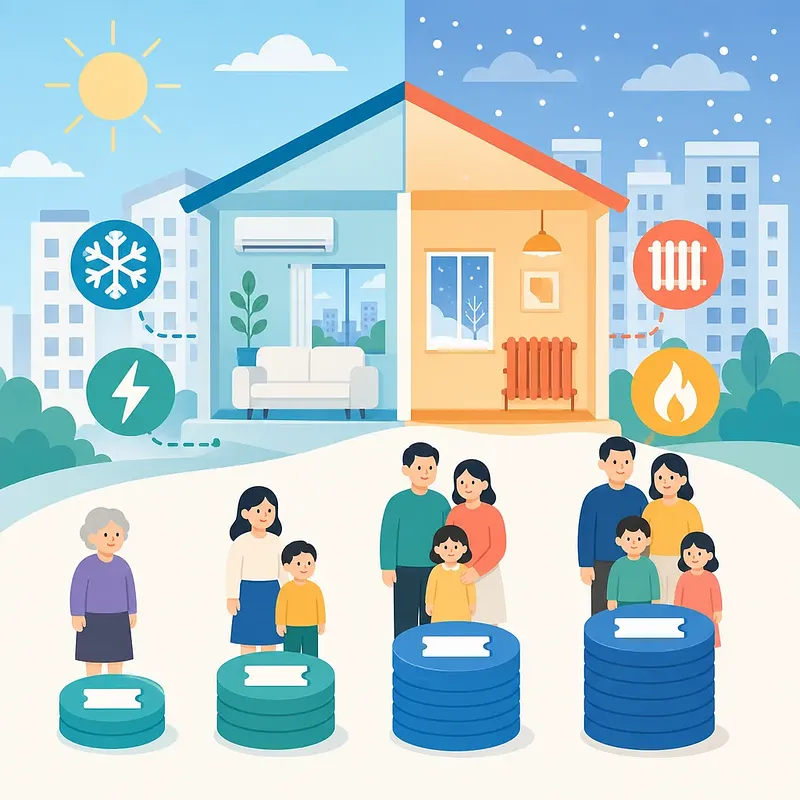
The 2026 support amounts are totals per household, not monthly payments. Standard support can be used during the usage period without being divided into summer and winter amounts. If a household wishes to receive other winter support, only the summer-only amounts below apply.
Number of household members on the resident registration record | Total support for 2026 | Summer-only amount when requesting other winter support
1 person | 295,200 won | 40,700 won
2 people | 407,500 won | 58,800 won
3 people | 532,700 won | 75,800 won
At least 4 people | 701,300 won | 102,000 won
The two amounts in the table are not added together. Any balance remaining after the usage deadline expires. The amounts and rules for remaining balances follow the agency’s support amount guide and 2026 card news.
Application Period and Where to Check Eligibility
The 2026 application period runs from June 15 through December 31 (South Korea). In-person applications are accepted at the eup, myeon, or dong administrative welfare center for the applicant’s registered place of residence. Online applications are submitted through Bokjiro. The consultation phone number is 1600-3190.
Eligibility can be checked in the following order.
· Check the types of basic livelihood security benefits received as of the application date.
· Compare the characteristics of the applicant and household members on the resident registration record against the criteria.
· Check whether anyone receives welfare facility benefits or other winter support.
· Ask the administrative welfare center which verification documents are required.
The basic document is an application for issuance of an energy voucher. Applications for bill deductions require a recent utility bill. Apartment residents should prepare their apartment management fee bill. Proxy applications require an in-person visit with documents including a letter of authorization and the representative’s identification.
Additional verification documents may be required for infants and young children, pregnancy, diseases, and other conditions. Proxy applications cannot be submitted online. Check the agency’s notices for the year-end system shutdown schedule. (Verified information: 2~3 days in late December 2026 · Source: energyv.or.kr · Checked on 2026-11-15)
Application methods follow the agency’s application guide, and additional documents follow the Bokjiro application notice.
Is the Application Automatic for Last Year’s Recipients?
Automatic application requires no changes in information and continued eligibility this year. Even last year’s recipients must submit a new application if they have moved or the number of household members has changed. If information changes while receiving support, recipients must notify the administrative welfare center and reapply.
How to Use the Voucher and Check the Balance
In summer, the voucher is used through electricity bill deductions. In winter, recipients choose either bill deductions or the National Happiness Card. The energy sources covered differ by payment method.
Method | Eligible energy sources | Usage period for the 2026 program
Summer bill deductions | Electricity | July 1 to September 30, 2026
Winter bill deductions | One of electricity, city gas, or district heating | October 1, 2026, to May 31, 2027
Winter National Happiness Card | Electricity, city gas, kerosene, LPG, and coal briquettes | October 3, 2026, to May 31, 2027
Bill deductions require the deduction application and the billing and preparation of the bill to take place by the deadline. Payments with the National Happiness Card must be completed within the usage period. Check with the supplier about card payment methods for electricity and city gas. Detailed conditions are in the agency’s usage guide.
The balance can be checked on Bokjiro during the usage period. The steps are as follows.
· Log in to Bokjiro using simplified authentication or another login method.
· Go from Welfare Wallet to My Welfare Wallet.
· Check the balance of the relevant voucher.
Detailed usage history can be checked through the agency’s chatbot or integrated consultation center. The steps for checking follow the agency’s balance inquiry guide.
Frequently Asked Questions
Can Someone Receiving Only Housing Benefits Qualify?
Receiving housing benefits alone satisfies the income criteria. There is no requirement to also receive livelihood or medical benefits. Household member characteristics and exclusion conditions must be checked separately.
Is Meeting the Age Condition Enough Without Being a Benefit Recipient?
The standard program also requires eligibility for basic livelihood security benefits. Meeting only the elderly or infant and young child condition is not enough. The coal briquette conversion program is assessed under separate criteria.
Must the Benefit Recipient Personally Be Elderly or Have a Disability?
The recipient does not need to personally meet the characteristic criteria. A household member on the same resident registration record may meet them instead. However, the applicant must still be eligible for basic livelihood security benefits.
Does Near-Poor Status Exclude Someone From All Energy Support?
The standard program’s income criteria differ from the criteria for other support programs. The coal briquette conversion program explicitly includes the near-poor as an eligible category. This program requires applicants to meet separate conditions, including boiler replacement.
Is the Same Amount Paid Every Month?
The stated amounts are the total support per household for 2026. They are not recurring monthly payments. The actual remaining balance can be checked on Bokjiro.