
Skip to content
Binder
Benefits & Support, a guide to government programs with who qualifies, when, and how to apply How-to 🇺🇸 United States

This content applies specifically to United States.

Medicare Extra Help 2026 Income and Asset Limits and How to Apply

Listen or read this article

11:07

Listen, or read the text only.

Medicare Extra Help 2026 Income and Asset Limits and How to Apply

Kokoro 82M AI-generated voice 12 min read

0:00 11:07

Advertisement

Download audio

File name
medicare-extra-help-2026-eligibility-application-en.mp3
Format
MP3 (audio/mpeg)
Duration
11:07
File size
7.63 MB
Engine
Kokoro 82M

This audio was generated by AI.

You may download and use it freely for personal use.

Medicare Extra Help 2026 Income and Asset Limits and How to Apply

8 min read

Medicare Extra Help 2026 Income and Asset Limits and How to Apply
The general 2026 Medicare Extra Help limits are an annual income of $23,940 and assets of $18,090 for individuals, and an annual income of $32,460 and assets of $36,100 for couples. If you do not qualify automatically, you can apply through Social Security at any time during the year. If approved, your Part D premiums, deductible, and out-of-pocket prescription drug costs will be reduced.
First, check whether you receive Medicaid, a Medicare Savings Program such as QMB·SLMB·QI, or SSI to determine whether you qualify automatically.
Compare the 2026 income and asset limits with your expected annual income and current financial assets, but apply even if you are slightly over the limits, taking deduction rules into account.
Prepare documents that verify the information in your application, such as bank statements, tax returns, wage and pension records, and IRA·401(k) statements.
Apply for Extra Help at any time during the year through the official Social Security website, by phone, or at a local office.
After reviewing the decision notice, check your Part D plan's formulary, network pharmacies, and any amount above the benchmark premium.
If Medicare Part D prescription drug costs are a burden, first check whether you automatically qualify. If you do not automatically qualify, prepare your bank, investment, retirement account, and income information and apply through Social Security. There is no set annual deadline, and you can apply at any time during the year or reapply after your income or assets decrease.
· Who should generally apply: Medicare beneficiaries who do not automatically qualify and may meet the income and asset requirements · General 2026 limits: Individual annual income of $23,940 and assets of $18,090; married couple annual income of $32,460 and assets of $36,100 · Application period: Any time during the year · Official application agency: Social Security · Information to prepare: Bank accounts, investments, IRA·401(k), wages, pensions, and tax return information
1. Check Whether You Automatically Qualify First
If any of the following applies to you, you generally qualify automatically for Extra Help and do not need to submit a separate application to Social Security.
· You receive both Medicaid and Medicare · You receive assistance from a Medicare Savings Program such as QMB, SLMB, or QI · You are enrolled in Medicare and receive Supplemental Security Income, or SSI
Medicare sends a related notice to people who automatically qualify. Even if you automatically qualify, you must be enrolled in a Part D plan or a Medicare Advantage plan that includes prescription drug coverage for Extra Help to apply to your actual prescriptions.
Even if you receive notice that your automatic eligibility has ended, you can apply directly through Social Security if your income and assets are within the general limits.
2. Check the 2026 Income and Asset Limits
The general limits published for 2026 are as follows.
Category | Annual income limit | Asset limit Individual | $23,940 | $18,090 Married couple living together | $32,460 | $36,100
These amounts are useful for a quick self-check, but Social Security makes the final determination after reviewing the application and any applicable exclusion rules.
Points to Consider When Determining Income
In addition to wages, Social Security benefits, pensions, and other regular income may be used in the determination. However, exclusions may apply to earned income or certain assistance payments, so it is best not to give up on applying simply because your total is slightly above the limit.
Income limits may be higher in Alaska and Hawaii. Higher limits may also apply if you financially support family members who live with you, so you should confirm your circumstances with Social Security.
Items Included as Assets
The following types of liquid financial assets are generally reviewed.
· Checking and savings accounts · Stocks, bonds, mutual funds, and other investment accounts · Retirement accounts such as IRA and 401(k) · Real estate other than your primary residence
Your primary residence, vehicles, household goods, personal belongings, and burial plots are generally excluded from the asset calculation. Exclusion rules may also apply to a certain amount set aside for burial expenses. Because the official asset limits account for the permitted burial-expense amount, accurately report the amount you actually own according to the questions on the application.
3. Prepare Information Before Applying
Gathering the following information before starting the online application can help you enter your income and assets more accurately.
· Recent bank statements and account balances · Statements for investment accounts such as stocks, bonds, and funds · Balances for IRA, 401(k), and other retirement accounts · Recent tax returns · Pay stubs or employment income records · Records of regular income such as Social Security benefits, pensions, and veterans benefits · Your spouse’s income and asset information if you live together
You do not need to attach all documents online. However, keep supporting records because Social Security may request additional verification or verify the amounts listed on your application.
4. Apply for Extra Help Through Social Security
If you do not automatically qualify, apply in the following order.
· Go to Social Security’s official Medicare Part D Extra Help page. · Select the online application and enter information about yourself and your spouse who lives with you. · Answer questions about income, bank accounts, investments, retirement accounts, and real estate. · Confirm whether your information may be sent to the state for a Medicare Savings Program review. · Review and submit the application, and keep a record of the submission. · Check Social Security’s determination notice and submit any requested additional information within the stated deadline.
If using the online service is difficult, you can apply by calling Social Security or through a local office. If you need hearing assistance, you can use the official TTY channel.
There is no set annual application deadline. Even if you were previously denied because of your income or assets, you can reapply if your circumstances change because of job loss, retirement, a spouse’s death, decreased assets, or another reason.
5. Part D Costs Reduced After Approval
When Extra Help applies in 2026, Part D costs are generally reduced as follows.
Cost item | 2026 Extra Help level Part D premium | $0 within the assistance benchmark Annual deductible | $0 Covered generic prescription drugs | Up to $5.10 per prescription Covered brand-name prescription drugs | Up to $12.65 per prescription
The prescription drug amounts in the table are maximums. Depending on Medicaid eligibility, whether you live in a facility, and other assistance conditions, your actual cost may be lower or $0. After reaching Part D’s annual out-of-pocket limit phase, your out-of-pocket cost for covered prescription drugs becomes $0.
Premium assistance is based on a regional benchmark premium. If the premium for your selected plan exceeds the assistance benchmark or includes additional benefits, you may still owe the difference, so review both your approval notice and your plan bill.
6. How Application Information Is Sent to the Medicare Savings Program
An Extra Help application may lead to a Medicare Savings Program review. Unless you indicate that you do not want this during the application process, Social Security may send your application information to your state’s Medicaid agency to begin a Medicare Savings Program application.
Depending on eligibility, a Medicare Savings Program may help pay Part B premiums and some deductibles and coinsurance. Extra Help primarily reduces Part D prescription drug costs, so the two programs cover different expenses.
Having your information sent to the state does not guarantee approval for a Medicare Savings Program. The state applies separate income and asset limits and may require additional documents or an interview.
7. Why You Should Review Your Part D Plan Even After Approval
Approval for Extra Help does not mean that all prescription drugs are automatically covered at the same price. Your actual costs and access are also affected by the rules of your selected Part D plan.
Check the following:
· Whether the medications you currently take are included in the plan’s formulary · Whether you can fill prescriptions at a preferred or network pharmacy · Whether prior authorization, step therapy, or quantity limits apply · Whether the plan premium exceeds the Extra Help assistance benchmark · Whether you can switch to a generic or an alternative preferred by the plan
After receiving an approval notice, it is therefore advisable to review your plan again based on your prescription list, dosages, and pharmacy. Extra Help is a cost-assistance program and does not determine the medical suitability of a particular medication or replace a plan’s formulary rules.
8. Respond to the Decision Notice and Reapply When Needed
Social Security provides written notice of an approval or denial. Check the notice for the effective date, level of assistance, and any additional steps you must take.
If you believe the decision is incorrect, follow the appeal method and deadline stated in the notice. If your income or assets change, you can reapply separately from the previous decision.
Automatic eligibility or Extra Help eligibility may be reviewed again later. Ignoring an eligibility verification request from Medicare, Social Security, or a state agency may cause your assistance to change, so keep your address current and submit requested documents by the deadline.
0:00 0:00
1 / 52

Advertisement

Download text

File name
medicare-extra-help-2026-eligibility-application-en.txt
Format
TXT (text/plain)
Paragraphs
52

Downloads exactly what you see as a text file.

Please cite the source when quoting.

Large text

Makes the text larger and the colors clearer. Turn it on if the text feels too small.

A woman reviews Medicare Extra Help application information with an adviser.

Key points

  • First, check whether you receive Medicaid, a Medicare Savings Program such as QMB·SLMB·QI, or SSI to determine whether you qualify automatically.
  • Compare the 2026 income and asset limits with your expected annual income and current financial assets, but apply even if you are slightly over the limits, taking deduction rules into account.
  • Prepare documents that verify the information in your application, such as bank statements, tax returns, wage and pension records, and IRA·401(k) statements.
  • Apply for Extra Help at any time during the year through the official Social Security website, by phone, or at a local office.
  • After reviewing the decision notice, check your Part D plan's formulary, network pharmacies, and any amount above the benchmark premium.

If Medicare Part D prescription drug costs are a burden, first check whether you automatically qualify. If you do not automatically qualify, prepare your bank, investment, retirement account, and income information and apply through Social Security. There is no set annual deadline, and you can apply at any time during the year or reapply after your income or assets decrease.

  • Who should generally apply: Medicare beneficiaries who do not automatically qualify and may meet the income and asset requirements
  • General 2026 limits: Individual annual income of $23,940 and assets of $18,090; married couple annual income of $32,460 and assets of $36,100
  • Application period: Any time during the year
  • Official application agency: Social Security
  • Information to prepare: Bank accounts, investments, IRA·401(k), wages, pensions, and tax return information

1. Check Whether You Automatically Qualify First

If any of the following applies to you, you generally qualify automatically for Extra Help and do not need to submit a separate application to Social Security.

  • You receive both Medicaid and Medicare
  • You receive assistance from a Medicare Savings Program such as QMB, SLMB, or QI
  • You are enrolled in Medicare and receive Supplemental Security Income, or SSI

Medicare sends a related notice to people who automatically qualify. Even if you automatically qualify, you must be enrolled in a Part D plan or a Medicare Advantage plan that includes prescription drug coverage for Extra Help to apply to your actual prescriptions.

Even if you receive notice that your automatic eligibility has ended, you can apply directly through Social Security if your income and assets are within the general limits.

2. Check the 2026 Income and Asset Limits

The general limits published for 2026 are as follows.

Category Annual income limit Asset limit
Individual $23,940 $18,090
Married couple living together $32,460 $36,100

These amounts are useful for a quick self-check, but Social Security makes the final determination after reviewing the application and any applicable exclusion rules.

Points to Consider When Determining Income

In addition to wages, Social Security benefits, pensions, and other regular income may be used in the determination. However, exclusions may apply to earned income or certain assistance payments, so it is best not to give up on applying simply because your total is slightly above the limit.

Income limits may be higher in Alaska and Hawaii. Higher limits may also apply if you financially support family members who live with you, so you should confirm your circumstances with Social Security.

Items Included as Assets

The following types of liquid financial assets are generally reviewed.

  • Checking and savings accounts
  • Stocks, bonds, mutual funds, and other investment accounts
  • Retirement accounts such as IRA and 401(k)
  • Real estate other than your primary residence

Your primary residence, vehicles, household goods, personal belongings, and burial plots are generally excluded from the asset calculation. Exclusion rules may also apply to a certain amount set aside for burial expenses. Because the official asset limits account for the permitted burial-expense amount, accurately report the amount you actually own according to the questions on the application.

3. Prepare Information Before Applying

Gathering the following information before starting the online application can help you enter your income and assets more accurately.

  • Recent bank statements and account balances
  • Statements for investment accounts such as stocks, bonds, and funds
  • Balances for IRA, 401(k), and other retirement accounts
  • Recent tax returns
  • Pay stubs or employment income records
  • Records of regular income such as Social Security benefits, pensions, and veterans benefits
  • Your spouse’s income and asset information if you live together

You do not need to attach all documents online. However, keep supporting records because Social Security may request additional verification or verify the amounts listed on your application.

4. Apply for Extra Help Through Social Security

If you do not automatically qualify, apply in the following order.

  1. Go to Social Security’s official Medicare Part D Extra Help page.
  2. Select the online application and enter information about yourself and your spouse who lives with you.
  3. Answer questions about income, bank accounts, investments, retirement accounts, and real estate.
  4. Confirm whether your information may be sent to the state for a Medicare Savings Program review.
  5. Review and submit the application, and keep a record of the submission.
  6. Check Social Security’s determination notice and submit any requested additional information within the stated deadline.

If using the online service is difficult, you can apply by calling Social Security or through a local office. If you need hearing assistance, you can use the official TTY channel.

There is no set annual application deadline. Even if you were previously denied because of your income or assets, you can reapply if your circumstances change because of job loss, retirement, a spouse’s death, decreased assets, or another reason.


5. Part D Costs Reduced After Approval

When Extra Help applies in 2026, Part D costs are generally reduced as follows.

Cost item 2026 Extra Help level
Part D premium $0 within the assistance benchmark
Annual deductible $0
Covered generic prescription drugs Up to $5.10 per prescription
Covered brand-name prescription drugs Up to $12.65 per prescription

The prescription drug amounts in the table are maximums. Depending on Medicaid eligibility, whether you live in a facility, and other assistance conditions, your actual cost may be lower or $0. After reaching Part D’s annual out-of-pocket limit phase, your out-of-pocket cost for covered prescription drugs becomes $0.

Premium assistance is based on a regional benchmark premium. If the premium for your selected plan exceeds the assistance benchmark or includes additional benefits, you may still owe the difference, so review both your approval notice and your plan bill.

6. How Application Information Is Sent to the Medicare Savings Program

An Extra Help application may lead to a Medicare Savings Program review. Unless you indicate that you do not want this during the application process, Social Security may send your application information to your state’s Medicaid agency to begin a Medicare Savings Program application.

Depending on eligibility, a Medicare Savings Program may help pay Part B premiums and some deductibles and coinsurance. Extra Help primarily reduces Part D prescription drug costs, so the two programs cover different expenses.

Having your information sent to the state does not guarantee approval for a Medicare Savings Program. The state applies separate income and asset limits and may require additional documents or an interview.

7. Why You Should Review Your Part D Plan Even After Approval

Approval for Extra Help does not mean that all prescription drugs are automatically covered at the same price. Your actual costs and access are also affected by the rules of your selected Part D plan.

Check the following:

  • Whether the medications you currently take are included in the plan’s formulary
  • Whether you can fill prescriptions at a preferred or network pharmacy
  • Whether prior authorization, step therapy, or quantity limits apply
  • Whether the plan premium exceeds the Extra Help assistance benchmark
  • Whether you can switch to a generic or an alternative preferred by the plan

After receiving an approval notice, it is therefore advisable to review your plan again based on your prescription list, dosages, and pharmacy. Extra Help is a cost-assistance program and does not determine the medical suitability of a particular medication or replace a plan’s formulary rules.

8. Respond to the Decision Notice and Reapply When Needed

Social Security provides written notice of an approval or denial. Check the notice for the effective date, level of assistance, and any additional steps you must take.

If you believe the decision is incorrect, follow the appeal method and deadline stated in the notice. If your income or assets change, you can reapply separately from the previous decision.

Automatic eligibility or Extra Help eligibility may be reviewed again later. Ignoring an eligibility verification request from Medicare, Social Security, or a state agency may cause your assistance to change, so keep your address current and submit requested documents by the deadline.

Apply now

Official Extra Help Application

If you are enrolled in Medicare, do not automatically qualify, and may meet the income and asset requirements, you can apply at any time of year. Have your bank account, investment and retirement account, wages, pension, and spouse's information ready. Social Security Home > Medicare > Part D Extra Help > Apply for Extra Help.

You are leaving for an external site that Injoys does not operate. Please re-check eligibility, dates, and amounts on that institution's own notice.

The institution may block access to this page from outside the target region (United States).

Go to the official page

Opens in a new window.

Advertisement

Sign-in required

Sign in with your Google account to like, comment, and save highlights.

Images

A woman reviews Medicare Extra Help application information with an adviser.
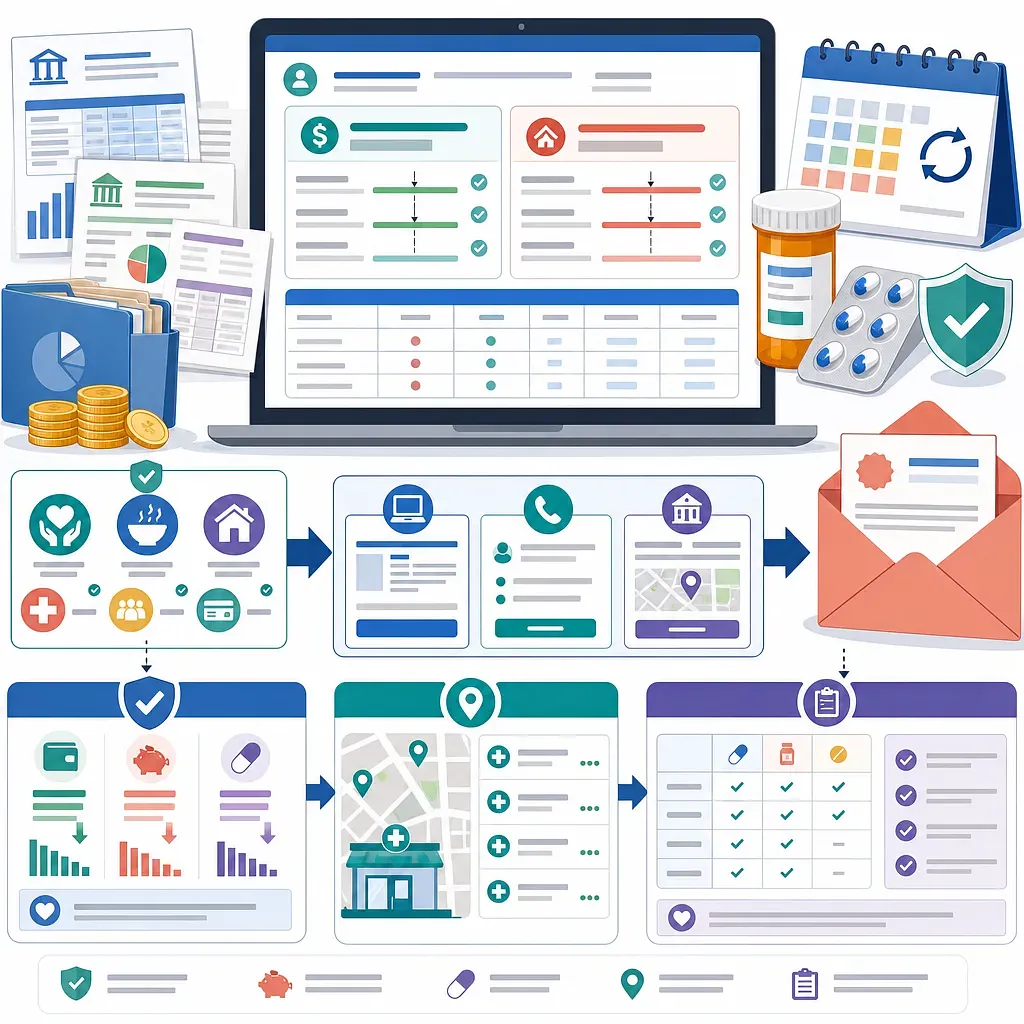
The infographic visualizes the financial review and prescription assistance process for Medicare Extra Help.

FAQ

What are the 2026 Medicare Extra Help income limits?

The standard limits are $23,940 in annual income for an individual and $32,460 for a married couple living together. Higher limits may apply to residents of Alaska or Hawaii or people who support family members living with them, and income exclusion rules are also taken into account in the final determination.

What are the 2026 Extra Help asset limits?

The standard limits are $18,090 for an individual and $36,100 for a married couple living together. Bank deposits, investment accounts, IRAs, 401(k)s, and real estate other than a primary residence may be reviewed, but a home, vehicle, household goods, and similar items are generally excluded.

When is the deadline to apply for Extra Help?

There is no set annual deadline, so you can apply at any time during the year. Even if you were previously denied, you can apply again if your circumstances change, such as a decrease in income or assets.

Who does not need to apply separately for Extra Help?

You are generally automatically eligible if you receive both Medicaid and Medicare, are enrolled in a Medicare Savings Program such as QMB, SLMB, or QI, or receive SSI while enrolled in Medicare. Be sure to review any Medicare notice about changes to your automatic eligibility.

How much will prescription drugs cost in 2026 if I am approved for Extra Help?

For covered prescription drugs, the standard maximum copayment is $5.10 per fill for generics and $12.65 for brand-name drugs. Depending on your eligibility category or living arrangement, you may pay less or pay $0.

If I am approved for Extra Help, will my Part D premium always be $0?

Premiums up to the Extra Help benchmark amount and the deductible are $0. However, if the premium for your selected plan exceeds the regional benchmark or includes the cost of additional benefits, you may still have to pay the difference.

What documents should I prepare when applying for Extra Help?

Prepare bank statements, investment account records, IRA and 401(k) balances, recent tax returns, pay stubs, and documentation of pensions and other regular income. If you live with your spouse, you may also need information about your spouse's income and assets.

When I apply for Extra Help, do I also automatically apply for a Medicare Savings Program?

Unless you decline to have your information shared during the application process, Social Security may send your information to the Medicaid agency in your state to initiate a Medicare Savings Program application. However, because the state separately determines eligibility, sharing the information itself does not mean that you are approved.

Can I not apply if my income or assets are slightly over the limits?

You may still apply even if the simple total is slightly over the limits. Exclusion rules may apply to some income and assets, and higher income limits may apply if you live in Alaska or Hawaii or support family members.

Does Extra Help cover all prescription drugs?

No. Extra Help lowers Part D costs, but each plan's rules regarding its formulary, network pharmacies, prior authorization, quantity limits, and similar requirements still apply. You must separately check whether the plan you select covers the medications you currently take.

Sources

Also available as video and a short read

Videos and a short write-up made from this content. Watch instead of reading, or skim the gist first.

Short version

Loading…

Data formats

This content is available in several machine-friendly formats.

Data-only languages (machine translated, files only)

Indonesian JSON MD Portuguese JSON MD Chinese (Traditional) JSON MD Deutsch JSON MD

Verification

Reviewed by 신익희 · 편집장 · 2026-08-26

Figures in this article were checked against the source material during generation. · 2026-08-26

This translation has been cross-checked by AI. · 2026-08-26

Reuse & AI usage

Search indexing and AI citation with attribution are welcome. See the license policy for details.

CC BY · License

Loading…

Loading…

From Injoys

Request the content you want and take 70% of what it earns

Just leave the subject. We handle production, review, translation and distribution.

See how revenue sharing works

Comments